
Cybersecurity is entering a new phase where understanding systems alone is no longer enough. Professionals are now expected to understand how intelligent systems behave, how they introduce risk, and how they impact compliance across the organisation.
Artificial intelligence is no longer a future concept in security. It is already being used in threat detection, fraud prevention, security automation, and risk analysis. At the same time, attackers are using AI to scale their efforts, making threats more advanced and harder to detect.
This shift is changing what it means to be a cybersecurity professional.
In 2026, the most valuable professionals will not only understand security frameworks and controls, but also how AI systems interact with those controls. This is where choosing the right AI certification for cybersecurity professionals becomes important. It is no longer about adding another credential. It is about building the right capability.
Why Cybersecurity Professionals Are Turning to AI Certifications
There is a clear gap in the market today.
Many professionals are experienced in cybersecurity but feel unprepared when it comes to AI. On the other side, many AI courses focus heavily on coding or data science, which does not align with the day-to-day responsibilities of security teams.
This creates confusion.
Professionals are left asking which skills actually matter and which certifications will help them stay relevant in their role.
The reality is simple. Cybersecurity roles are expanding. Teams are expected to evaluate AI tools, assess their risks, ensure compliance, and make decisions that affect the entire organisation. Without structured knowledge of AI in a security context, these responsibilities become difficult to handle.
This is why more professionals are now looking for certifications that sit at the intersection of AI, security, and compliance rather than choosing generic AI courses.
Quick link: PathCert AI – From Career Clarity to AI Certification
What Makes an AI Certification Valuable for Cybersecurity Roles
Not every AI certification is useful for someone working in cybersecurity. The value of a certification depends on how well it aligns with real-world responsibilities.
A strong certification should first connect AI concepts with security use cases. It should explain how AI is applied in threat detection, identity management, monitoring, and risk analysis instead of focusing only on theory.
It should also include compliance and governance. Security today is closely tied to regulations, and AI introduces new challenges in this area. Professionals need to understand how AI systems can remain compliant with standards and how to manage audits in an AI-driven environment.
Another important factor is practical application. Learning concepts without understanding how to use them in real scenarios does not create value. The certification should help professionals make better decisions in their current role.
Finally, the learning should be role-based. Cybersecurity professionals have different needs compared to developers or data scientists. A certification that does not recognise this difference often feels disconnected from real work.
The Best AI Certification for Cybersecurity Professionals in 2026
AI+ Security Compliance™
Among the options available today, AI+ Security Compliance™ stands out because it is built specifically for professionals working in security, risk, and compliance roles.
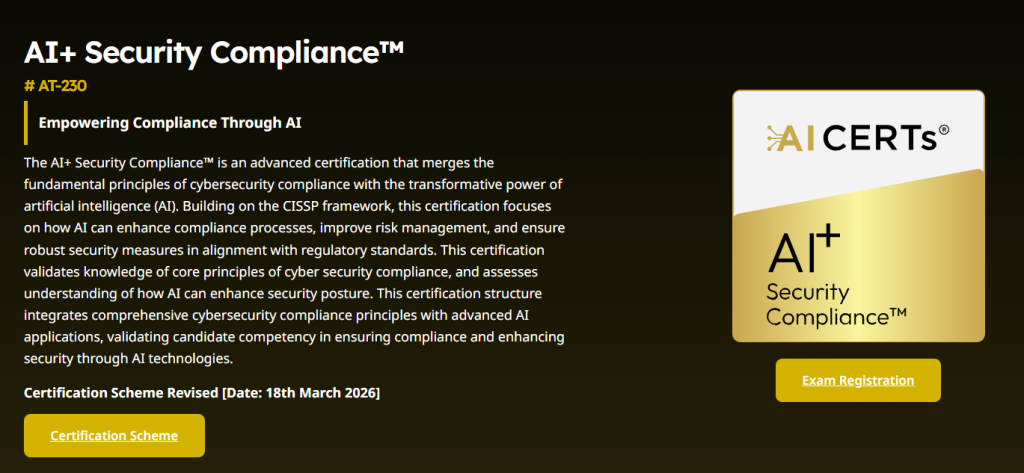
You can explore the certification in detail here: https://cyberpath.net/ai-security-compliance/
This certification does not treat AI as a separate subject. Instead, it integrates AI directly into cybersecurity and compliance practices, which makes it far more relevant for working professionals.
What You Actually Learn in AI+ Security Compliance™
The structure of this certification reflects real challenges faced by security teams.
It covers how AI can be used in risk management, allowing professionals to assess and prioritise threats more effectively. It also focuses on compliance frameworks, helping professionals understand how AI systems can align with regulatory requirements.
Another key area is identity and access management, where AI plays a growing role in detecting unusual behaviour and preventing breaches. The certification also addresses secure system design, ensuring that AI-driven systems are built with security in mind from the beginning.
In addition, it includes topics such as auditing, monitoring, and incident response, all enhanced with AI capabilities. This makes the learning directly applicable to daily work.
Why AI+ Security Compliance™ Is Different From Other AI Certifications
The biggest difference is its focus.
Most AI certifications try to cover everything. They introduce machine learning concepts, tools, and models, but they often leave professionals wondering how to apply this knowledge in their role.
AI+ Security Compliance™ takes a different approach by focusing only on what matters for security professionals.
It bridges the gap between AI theory and security practice. It also places strong emphasis on governance and compliance, which is often missing in general AI courses.
Another important point is that it aligns with how organisations operate. Security teams do not work in isolation. They are part of a larger system that includes legal, compliance, and leadership functions. This certification reflects that reality by connecting AI decisions with business impact.
Who Should Consider This Certification
This certification is suitable for professionals who are already working in or around cybersecurity and want to expand their capability.
It is particularly useful for security engineers, GRC professionals, compliance managers, and risk analysts who are starting to deal with AI-driven systems in their organisation.
It also makes sense for IT leaders and consultants who are responsible for guiding AI adoption while ensuring that security and compliance are not compromised.
Common Mistakes When Choosing an AI Certification
Many professionals approach AI learning in a way that slows down their progress.
One common mistake is choosing courses based on popularity rather than relevance. Just because a course is widely known does not mean it will be useful for a cybersecurity role.
Another mistake is focusing only on tools. Learning how to use a specific tool can be helpful, but without understanding the underlying systems and risks, the knowledge remains limited.
Some professionals also ignore compliance, assuming it can be handled separately. In reality, compliance is deeply connected to how AI systems are designed and used.
Finally, many people learn without a clear path. They jump between topics and courses, which leads to confusion instead of clarity.
Why Structure Matters More Than Content
The main challenge in AI learning today is not access to information. There is more content available than ever before.
The real challenge is knowing what to learn, in what order, and how to apply it.
This is where most professionals struggle.
They spend time learning different concepts but still feel unsure about how everything connects. This lack of structure prevents them from building real capability.
A structured approach solves this problem by guiding professionals through a clear path that aligns with their role and goals.
How Cyberpath Supports Cybersecurity Professionals
Cyberpath is designed to solve the problem of unstructured learning.
Instead of offering a large library of disconnected courses, it focuses on helping professionals choose the right path and apply what they learn in real situations.
The platform combines recognised certifications with guided learning, making it easier for professionals to move from understanding concepts to using them in their work.
This approach is especially useful for cybersecurity professionals who need both technical clarity and decision-making confidence.
PathCert AI Program: Turning Certification Into Capability
For professionals who want more than just a certificate, Cyberpath offers the PathCert AI program.
This program is designed to provide structure and support throughout the learning journey.
It helps professionals understand which certification fits their role, prepares them for the exam, and most importantly, shows them how to apply the knowledge in real scenarios.
The focus is not only on passing an exam but on building the ability to handle real challenges related to AI, security, and compliance.
For cybersecurity professionals, this makes a significant difference. Instead of learning in isolation, they follow a guided path that connects directly to their work.
Final Thoughts
The role of cybersecurity professionals is evolving quickly, and AI is becoming a core part of that change.
Choosing the right AI certification for cybersecurity professionals is not about following trends or collecting credentials. It is about building the right skills to handle modern security challenges.
AI+ Security Compliance™ stands out because it focuses on the intersection of AI, security, and compliance, which reflects the real demands of today’s roles.
When combined with a structured learning approach like Cyberpath’s PathCert AI program, it gives professionals a clear path to grow, stay relevant, and make better decisions in their work.
FAQs
The best AI certification for cybersecurity professionals in 2026 is AI+ Security Compliance™ because it focuses on how AI applies to security, risk management, and compliance. It is designed specifically for professionals working in cybersecurity roles rather than general AI learners.
Yes, cybersecurity professionals increasingly need AI certifications because modern security tools and threats involve artificial intelligence. Understanding how AI works in threat detection, risk analysis, and compliance helps professionals stay relevant and make better decisions in their roles.
Cyberpath helps professionals choose the right AI certification based on their role and provides a structured learning path through programs like PathCert AI. This approach ensures that learners not only prepare for certification but also understand how to apply AI in real cybersecurity environments.